
How Much Does It Cost to Build a Modern App in 2025?
Introduction: The Million-Dollar Question
In 2025, one of the first questions investors, entrepreneurs, and even established companies ask when planning a new app is simple:
“How much is this going to cost us?”
The answer isn’t as straightforward as it used to be. In the early days of app stores, you could commission a basic iPhone app for a few thousand dollars. Today, expectations are higher, ecosystems are broader, and compliance is tougher. Some apps can still be built on lean budgets, but ambitious products rival the cost of small software companies.
This guide breaks down the real costs of app development in 2025, from simple MVPs to AI-driven platforms.
The Big Drivers of App Costs in 2025
App budgets vary because of six main cost drivers:
- Feature Complexity
- A to-do list app with offline storage is cheap.
- A fintech app with biometric login, AI fraud detection, and real-time payments is not.
- Design Quality
- Users expect sleek, intuitive design in 2025. Mediocre UI/UX kills adoption.
- Advanced motion design, 3D interfaces, or AR features increase costs significantly.
- Platform Coverage
- iOS only? Cheaper.
- iOS + Android + Web? Costs multiply.
- Add wearables, smart TVs, AR headsets? Even higher.
- Development Approach
- No-code/low-code → fastest, cheapest, but limited.
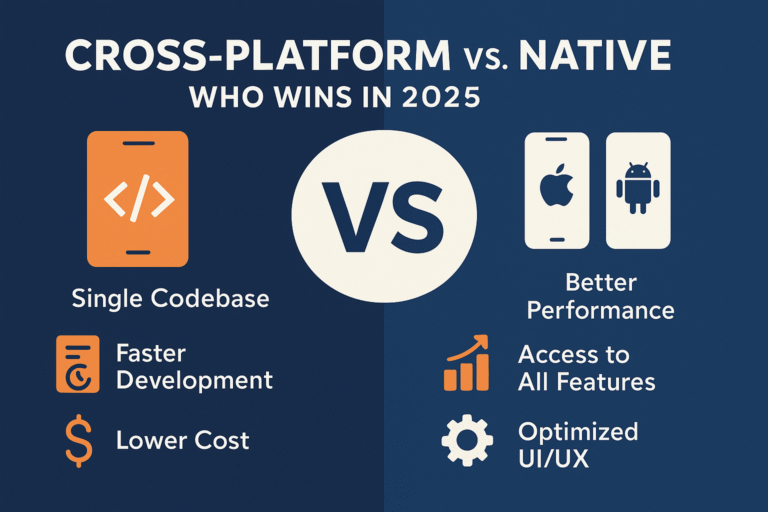
- Cross-platform frameworks (Flutter, React Native, Kotlin Multiplatform) → balance cost and performance.
- Native (Swift + Kotlin) → highest cost but best performance and access to features.
- Compliance & Security
- Apps in healthcare, fintech, or education must meet strict regulations (HIPAA, PCI DSS, GDPR, EU AI Act).
- Security audits, data encryption, and compliance frameworks add tens of thousands to costs.
- Location of Development Team
- US & Western Europe developers: $80–200/hour.
- Eastern Europe, Latin America: $40–80/hour.
- Asia (India, Vietnam, Philippines): $20–50/hour.
Cost Ranges by App Type in 2025
Here’s a breakdown of typical costs for modern apps in 2025.
| App Type | Features | Estimated Cost Range (USD) |
|---|---|---|
| Simple Utility App | Basic login, offline storage, few screens | $25,000 – $60,000 |
| Content App (News, Blog, Media) | Feeds, push notifications, CMS integration | $40,000 – $100,000 |
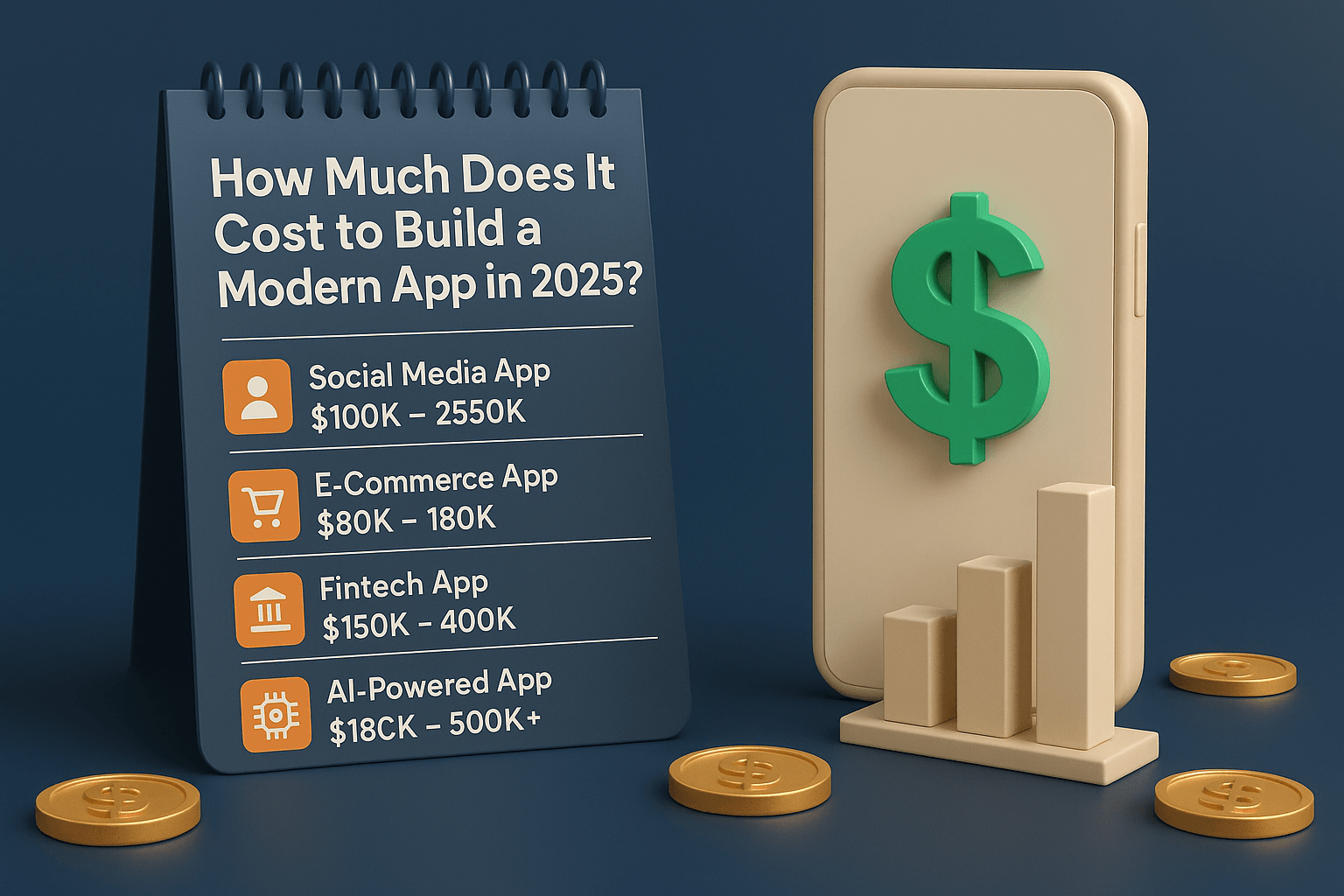
| E-Commerce App | Catalog, shopping cart, payments, analytics | $80,000 – $180,000 |
| Social Media App | Profiles, feeds, messaging, media uploads | $100,000 – $250,000 |
| On-Demand Marketplace | Booking, maps, payments, user accounts | $120,000 – $300,000 |
| Fintech / Banking App | KYC, biometric login, transactions, AI insights | $150,000 – $400,000 |
| AI-Powered App | Personalization, chatbots, generative AI | $180,000 – $500,000+ |
| Enterprise App | Integrations, dashboards, compliance | $200,000 – $600,000+ |
How AI Is Changing the Price Tag
2025 is the year AI became mainstream in apps. But “adding AI” isn’t one cost—it depends on how deep you go:
- Basic AI integration (chatbot, personalization): +$15k–$50k
- Generative AI features (text, image, voice): +$40k–$120k
- Custom AI models (training on your own data): +$100k–$300k+
Off-the-shelf APIs (OpenAI, Anthropic, Google) lower costs, but they also introduce ongoing fees (usage-based pricing can reach thousands per month at scale).
Hidden Costs Developers Forget
It’s easy to underestimate app budgets by only thinking about initial build costs. In 2025, hidden costs include:
- Ongoing Maintenance: ~20–25% of initial cost per year.
- Cloud Hosting: $500–$10,000/month depending on traffic.
- Licensing / API Fees: Maps, payments, AI APIs.
- App Store Fees: Apple (15–30% cut), Google Play (same).
- Security Audits: $10k–$50k annually for regulated apps.
A $150,000 app often requires $30,000–$50,000 per year just to stay alive and compliant.
Building Approaches: Which Saves Money?
1. No-Code / Low-Code
- Tools: Bubble, Adalo, Glide.
- Cost: $5,000–$25,000.
- Good for MVPs, prototypes, or internal business apps.
- Limitations: Not scalable, not great for complex apps.
2. Cross-Platform Development
- Tools: Flutter, React Native, Kotlin Multiplatform.
- Cost: $50,000–$200,000+.
- Pros: One codebase for iOS + Android.
- Cons: May lag behind native features.
3. Native Development
- Tools: Swift (iOS), Kotlin (Android).
- Cost: $80,000–$400,000+.
- Pros: Best performance, full feature access.
- Cons: Two separate teams = double the cost.
In 2025, most startups choose cross-platform for cost efficiency, while enterprises stick to native for security and performance.
The Regional Cost Breakdown
Hiring location in 2025 massively impacts costs.
| Region | Hourly Rates (USD) | Typical Project Cost |
|---|---|---|
| US & Canada | $100 – $200/hour | $150,000 – $400,000+ |
| Western Europe | $80 – $150/hour | $120,000 – $350,000 |
| Eastern Europe | $40 – $80/hour | $70,000 – $250,000 |
| Latin America | $35 – $75/hour | $60,000 – $200,000 |
| South Asia (India) | $25 – $60/hour | $40,000 – $150,000 |
| Southeast Asia | $20 – $50/hour | $30,000 – $120,000 |
Cost Examples by Scenario
Example 1: Startup MVP
- Cross-platform Flutter app.
- Features: login, profiles, simple payments.
- Team: 3 developers + 1 designer + QA.
- Cost: $60,000 – $120,000.
Example 2: Fintech App
- Native iOS + Android.
- Features: biometric login, transactions, AI fraud detection.
- Security audits + compliance.
- Team: 8–10 specialists.
- Cost: $200,000 – $400,000.
Example 3: AI-Powered Social App
- Cross-platform + AI API integrations.
- Features: content feed, AI-generated posts, chat assistant.
- Team: 6–8 developers.
- Cost: $150,000 – $350,000.
Why Costs Keep Rising (and Falling)
It sounds paradoxical, but in 2025 app costs are rising and falling at the same time.
- Rising: Users demand more polished apps with AI, compliance, advanced design. Expectations are higher, so “cheap” apps flop.
- Falling: No-code tools, AI-assisted coding, and cross-platform frameworks have reduced the baseline cost for simpler projects.
The gap between a basic app and a serious product has never been wider.
Strategic Ways to Cut Costs in 2025
- Build MVPs lean. Don’t add every feature upfront—validate with core functionality.
- Use AI-assisted coding. Tools like GitHub Copilot, ChatGPT, and Replit Ghostwriter can save 20–30% of dev time.
- Outsource wisely. Eastern Europe and Latin America offer strong talent at mid-tier prices.
- Plan compliance early. Retroactive fixes are expensive.
- Re-use components. Open-source UI kits, authentication libraries, and payment modules speed development.
The Real Answer to “How Much Does It Cost?”
If you ask five agencies in 2025, you’ll get five wildly different quotes. But here’s the distilled truth:
- Side project / prototype: $5k–$30k
- Startup MVP: $60k–$120k
- Mid-tier business app: $100k–$250k
- Enterprise or AI-heavy app: $200k–$600k+
The key is aligning budget with ambition. Too cheap, and you’ll launch something nobody wants. Too expensive, and you’ll burn money before product-market fit.
Closing Thought
So, how much does it cost to build a modern app in 2025?
Enough that you can’t treat it like a side experiment anymore. But not so much that innovation is out of reach.
The right question isn’t just “How much will it cost?” It’s also:
- “How much can we save by building smarter?”
- “What corners can we cut without losing trust?”
- “What investments today will pay off in retention tomorrow?”
Because in 2025, apps aren’t just lines of code. They’re products of strategy, trust, and vision. And the cost of building one reflects exactly that.