

Cross-Platform vs. Native Development: Who Wins in 2025?
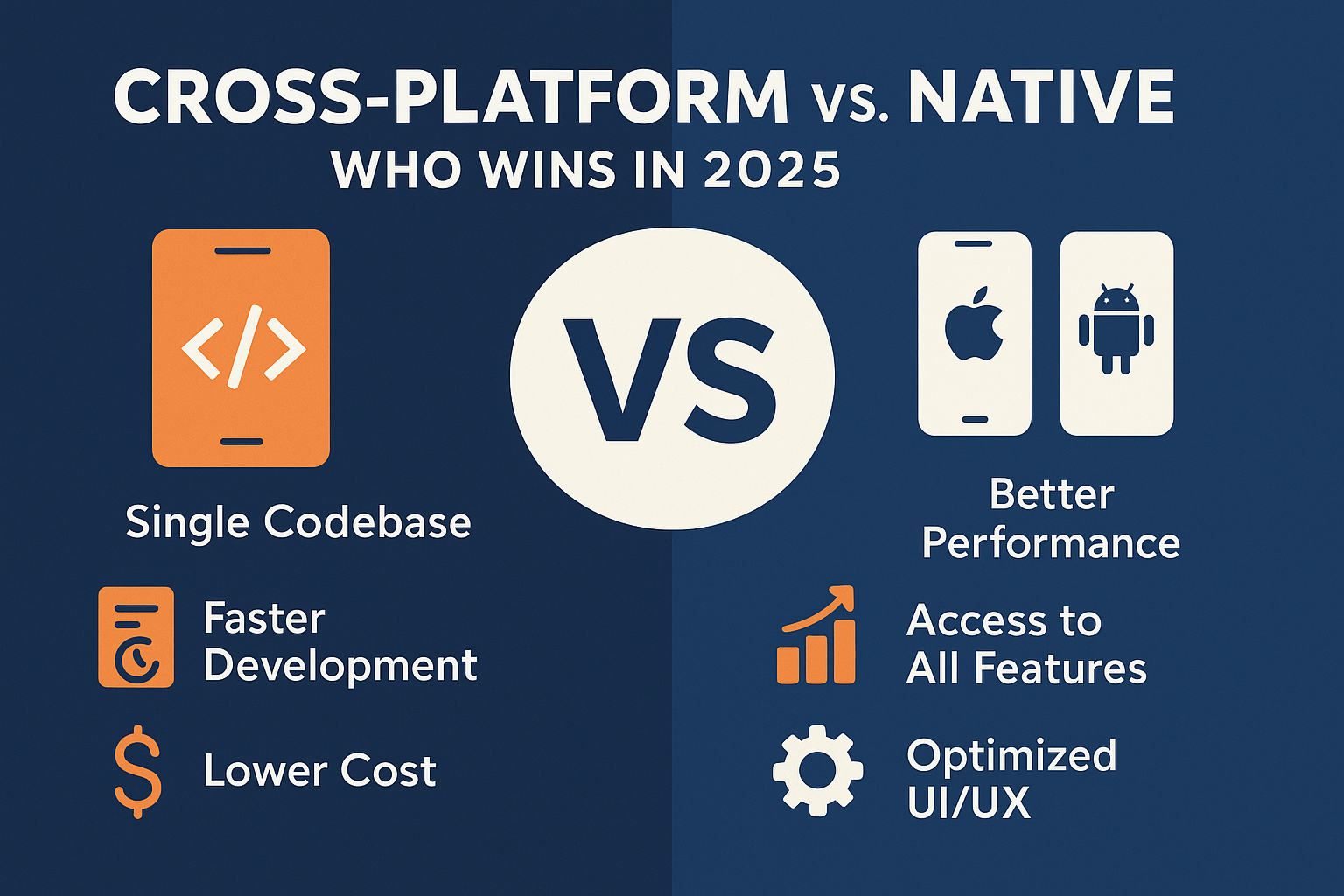
The mobile app ecosystem has matured into a trillion-dollar industry. Every year, new frameworks, tools, and platforms emerge, giving businesses more options for how to build their applications. But one debate continues to dominate the conversation: cross-platform vs. native development.
In 2025, this debate has never been more relevant. With advances in frameworks like Flutter, React Native, and Kotlin Multiplatform, cross-platform solutions promise cost-efficiency and speed. Meanwhile, native development (iOS with Swift/SwiftUI, Android with Kotlin/Jetpack Compose) continues to be the gold standard for performance, reliability, and deep integration.
So, who wins in 2025? The answer depends on your priorities. Let’s break it down.
1. Understanding the Basics
Native Development
Native development means building separate apps for iOS and Android using their official programming languages and tools.
- iOS apps are built using Swift or Objective-C with Xcode.
- Android apps are built using Kotlin or Java with Android Studio.
Because native apps are written in platform-specific code, they take full advantage of each operating system’s features and APIs.
Cross-Platform Development
Cross-platform frameworks allow developers to write a single codebase that runs on multiple platforms (iOS, Android, sometimes web and desktop). Popular frameworks include:
- Flutter (Google)
- React Native (Meta)
- Kotlin Multiplatform (JetBrains)
- .NET MAUI (Microsoft)
The appeal? Write once, deploy everywhere.
2. Performance in 2025: The Gap Is Narrowing
For years, the strongest argument for native apps was performance. But in 2025, the performance gap has significantly narrowed.
- Flutter’s Dart engine compiles directly to native ARM code, offering near-native performance.
- React Native with Hermes engine drastically improves startup times and memory usage.
- Kotlin Multiplatform allows for shared business logic while keeping platform-specific UI native, ensuring performance parity.
Still, native apps remain unbeatable for graphics-heavy applications like AAA mobile games, AR/VR experiences, or apps requiring complex background processing. For most business apps, however, cross-platform frameworks now deliver performance that’s “good enough” — sometimes indistinguishable from native.
3. Development Speed and Cost
Native
- Slower and more expensive since two separate teams (iOS and Android) may be required.
- Updates need to be implemented separately for each platform.
- Best suited for companies with large budgets or when app quality is mission-critical.
Cross-Platform
- Faster and cheaper since one codebase serves multiple platforms.
- Shared logic reduces development time by up to 40–50%.
- Ideal for startups, MVPs, or businesses needing quick time-to-market.
👉 In 2025, with global talent shortages and rising developer salaries, cost-efficiency is pushing more businesses toward cross-platform solutions.
4. User Experience (UX) and Design
- Native apps have the advantage when it comes to delivering a seamless experience aligned with each platform’s design guidelines (iOS Human Interface Guidelines, Android Material Design). Animations, gestures, and transitions feel perfectly natural.
- Cross-platform apps have improved significantly, especially with Flutter’s custom rendering engine. In fact, Flutter’s UI consistency across devices is a big advantage for brands that want a uniform look and feel.
The trade-off:
- If platform-specific UX details (like iOS’s navigation style vs. Android’s back button behavior) matter to your audience, native is still the winner.
- If brand consistency across all platforms is more important, cross-platform can deliver it more easily.
5. Access to Device Features
2025 brings increasingly complex device ecosystems—foldable phones, AR glasses, wearables, IoT integration.
- Native development offers immediate access to the newest APIs and device features (camera, biometrics, sensors, ARKit, etc.).
- Cross-platform frameworks often need time to catch up. For example, when Apple releases a new iOS feature, native developers can use it instantly, but cross-platform developers must wait for framework updates or write custom native modules.
For businesses in industries like healthtech, fintech, or gaming, where cutting-edge device features are critical, native remains superior.
6. Maintenance and Scalability
- Native apps require maintaining two separate codebases, which increases long-term costs. However, they are less prone to framework-related risks.
- Cross-platform apps are easier to maintain since logic is centralized. Updates roll out faster across platforms.
⚠️ One risk in 2025: framework dependency. If a framework loses support (as Xamarin has struggled in recent years), businesses may face migration challenges. Native apps, being tied to the OS itself, never face this issue.
7. Security in 2025
With stricter global regulations (EU AI Act, GDPR, US state privacy laws), app security in 2025 is non-negotiable.
- Native apps benefit from platform-level security, encryption, and compliance features.
- Cross-platform apps can also be secure, but integrating native-level security sometimes requires writing custom modules.
Verdict: For apps handling sensitive data (banking, healthcare, government), native apps still provide more robust security options.
8. Case Studies: Who Chooses What in 2025?
Companies Choosing Native
- Apple and Google apps themselves are always native, ensuring the best use of their ecosystems.
- Mobile-first banks prefer native for unmatched security and compliance.
- Gaming companies rely on native for graphics and performance.
Companies Choosing Cross-Platform
- Startups launching MVPs to test markets.
- Retail and e-commerce brands (e.g., Shopify apps built with Flutter).
- Content and media apps that prioritize fast rollout over cutting-edge device features.
9. The Developer Ecosystem in 2025
The job market is also influencing the debate:
- Native development talent is abundant but expensive, especially in the US and Western Europe.
- Cross-platform developers are in high demand, and frameworks like Flutter have rapidly growing communities.
In 2025, many developers are hybrid-skilled, capable of working across native and cross-platform environments, which is further blurring the lines.
10. The Role of AI in Development
One major 2025 trend is AI-assisted coding. Tools like GitHub Copilot, ChatGPT-powered IDEs, and AI debugging assistants are accelerating development.
- Cross-platform apps benefit greatly from AI since repetitive tasks can be automated across platforms.
- Native apps also benefit, but the complexity of handling two separate codebases remains.
AI doesn’t eliminate the debate—it amplifies the benefits of whichever approach you choose.
11. Costs in 2025: Numbers Matter
On average (based on global development rates in 2025):
- Native iOS + Android apps: $80,000–$250,000 for full-feature development.
- Cross-platform app: $50,000–$180,000 for equivalent functionality.
For ongoing maintenance:
- Native apps cost ~25–30% more annually since both platforms need updates.
- Cross-platform apps are ~15–20% cheaper to maintain.
For startups or SMEs, this cost difference is decisive. For enterprises, the higher upfront investment in native can be justified by long-term ROI.
12. Who Wins in 2025?
The answer depends on your priorities:
- Choose Native if…
- Your app relies heavily on device hardware or OS-specific features.
- You’re building performance-critical applications (games, AR, fintech).
- Security and compliance are top priorities.
- You have the budget and time to invest.
- Choose Cross-Platform if…
- You want to reach the market quickly and cost-effectively.
- Your app doesn’t rely on cutting-edge device features.
- Brand consistency across platforms matters more than OS-specific quirks.
- You need rapid iteration and scalability.
13. The Hybrid Future
In 2025, the “winner” isn’t necessarily one over the other. Increasingly, companies are adopting hybrid approaches:
- Shared logic through Kotlin Multiplatform, with native UI layers.
- Cross-platform base apps with native modules for advanced features.
- Super apps that combine web, cross-platform, and native components.
This hybrid strategy allows businesses to balance cost, speed, and performance.
Final Thoughts
So, who wins in 2025 — cross-platform or native development?
The truth is, both do.
- Native apps still dominate industries where performance, security, and innovation are non-negotiable.
- Cross-platform apps win for startups, SMEs, and brands prioritizing speed, cost-efficiency, and wide reach.
The real breakthrough of 2025 is that businesses no longer need to see this debate as “either/or.” With AI, hybrid frameworks, and maturing cross-platform tools, companies can finally choose the best of both worlds—without compromising on user experience or business goals.