
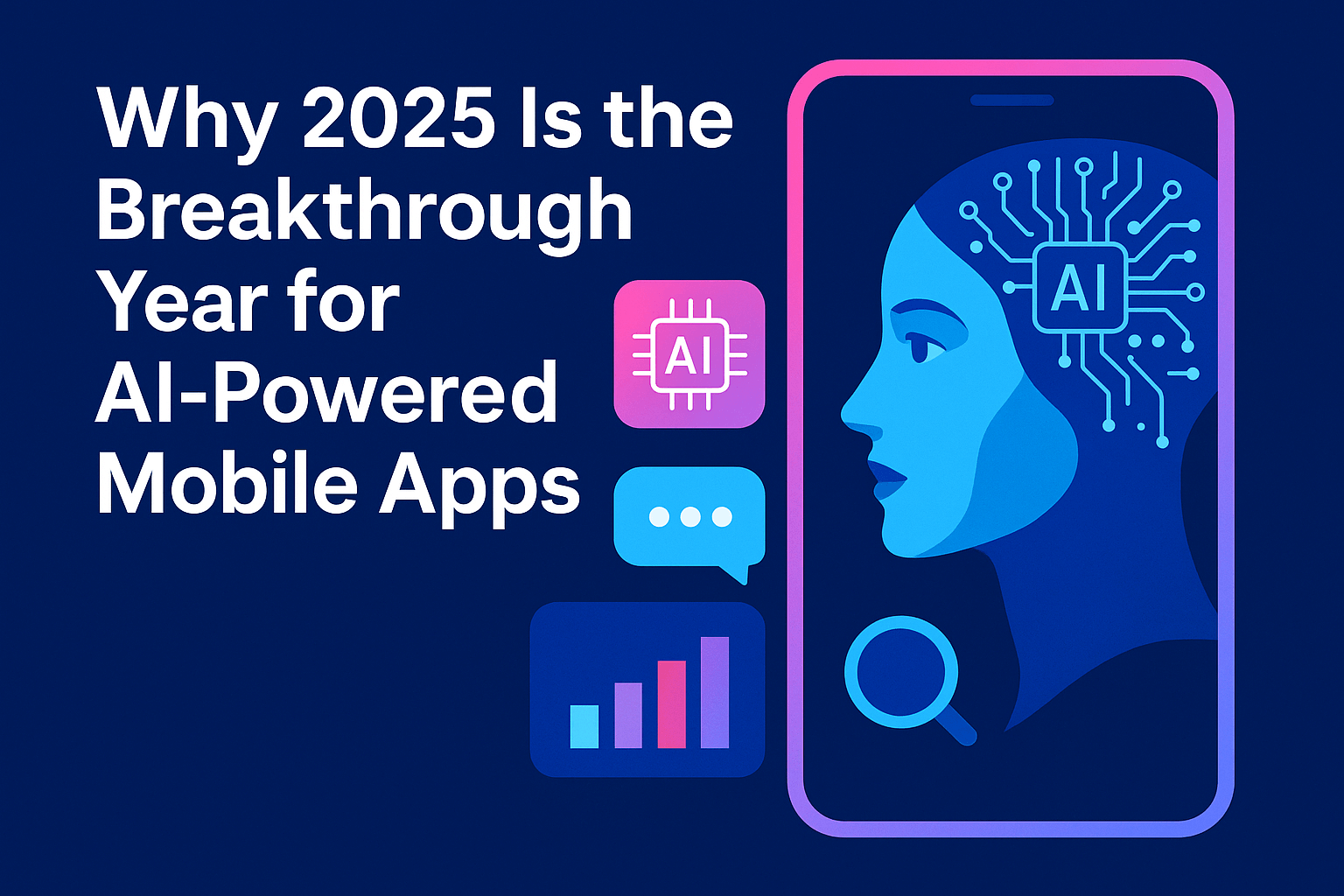
Why 2025 Is the Breakthrough Year for AI-Powered Mobile Apps
Artificial Intelligence (AI) has been a buzzword for years, but 2025 is the year when AI-powered mobile apps finally break into the mainstream. Once considered futuristic add-ons, AI features are now driving the core functionality of apps in industries from finance and healthcare to retail and entertainment.
For businesses, app developers, and consumers alike, the impact is undeniable. The year 2025 represents the turning point where AI isn’t just supporting apps—it’s redefining how apps are conceived, designed, and experienced.
In this article, we’ll explore why 2025 is the breakthrough year for AI-powered mobile apps, what trends are leading the charge, and how businesses can capitalize on this digital transformation.
1. The Shift From Supportive AI to Core AI Functionality
Until recently, AI in apps was mostly about support: smart search, chatbot assistance, or predictive text. In 2025, AI is the core engine.
- Healthcare apps now analyze biometric data in real time to recommend treatment plans.
- Finance apps detect fraud by monitoring unusual spending patterns instantly.
- E-commerce apps predict shopping needs before users even search.
Instead of simply adding value, AI is now defining the app itself.
2. The Rise of Generative AI in Mobile Applications
Generative AI is no longer limited to content creators—it’s embedded in everyday mobile apps.
- Language learning apps generate personalized lessons based on user strengths and weaknesses.
- Travel apps create custom itineraries in seconds, factoring in budget, weather, and preferences.
- Music and entertainment apps compose tracks or videos tailored to each user.
This shift from recommendation to creation is why 2025 feels different: apps are no longer passive tools but active collaborators.
3. Personalization at a Whole New Level
Personalization has always been a goal of mobile apps. But AI in 2025 enables context-aware personalization:
- A food delivery app can suggest meals not only based on past orders, but also the weather, time of day, and even your health data.
- Fitness apps track sleep patterns, stress levels, and biometrics to design workouts that evolve daily.
- Streaming platforms use AI to predict not just what you want to watch, but when you’re most likely to watch it.
This hyper-personalization increases engagement, retention, and customer satisfaction.
4. AI + 5G (and the Dawn of 6G): Real-Time Intelligence
The rollout of 5G and early experiments with 6G are crucial to AI’s app dominance in 2025. With ultra-low latency, apps can now perform AI computations in real time.
- Augmented Reality (AR) shopping apps let you virtually try on clothes without lag.
- Healthcare monitoring apps detect anomalies instantly and alert doctors.
- Gaming apps use AI for smarter NPCs and adaptive storylines that respond dynamically.
When combined with edge computing, apps can process data on the device itself—improving speed, reducing cloud dependency, and boosting privacy.
5. Privacy and Ethical AI: The Challenge of 2025
With great AI power comes great responsibility. Governments worldwide are tightening data regulations, and in 2025, compliance is no longer optional.
- Europe’s AI Act sets strict rules for AI deployment.
- The U.S. and Asia are moving toward data sovereignty laws.
- Users themselves are demanding transparency in how apps collect and use data.
The winners in this new landscape will be developers who balance AI innovation with ethical design. Apps that respect privacy while still delivering personalized experiences will gain user trust and loyalty.
6. Business Impact: From Cost Saving to Revenue Growth
AI in apps is not just about user experience—it’s about business survival.
- Automation: Apps automate tasks like customer support, financial forecasting, and supply chain management.
- Predictive analytics: Businesses can anticipate market shifts and user needs with high accuracy.
- Monetization: AI-driven personalization leads to higher conversion rates, increased ad relevance, and stronger subscription retention.
Companies that invest in AI app development in 2025 are likely to see significant ROI compared to competitors still relying on traditional mobile experiences.
7. Case Studies: How AI Apps Are Winning in 2025
Healthcare: Ada Health
AI-driven health apps like Ada now diagnose symptoms with accuracy levels comparable to human doctors. In 2025, such apps integrate seamlessly with wearables, giving users instant feedback on their health.
Finance: Revolut & PayPal
Mobile banking apps are using AI to offer real-time fraud detection and investment advice. Revolut, for example, leverages AI to detect unusual spending patterns instantly.
E-commerce: Amazon & Shopify Apps
Amazon’s app has long used AI for product recommendations, but in 2025 it’s going further—personalizing entire shopping journeys. Shopify apps for merchants use AI to predict what products will trend next month.
Entertainment: Netflix & Spotify
Streaming apps don’t just suggest content—they’re now generating content previews, custom playlists, and even interactive AI-driven storylines.
8. Future Outlook: Beyond 2025
If 2025 is the breakthrough year, what comes next?
- AI companions: Apps that act like personal digital assistants across every aspect of life.
- Multimodal AI apps: Apps that combine text, voice, images, and video into seamless experiences.
- Decentralized AI: With blockchain integration, apps will allow users to control their own AI models and data.
In short, 2025 is the year AI proves its value—and the foundation for an even more intelligent mobile future.
Final Thoughts
2025 isn’t just another year in app development—it’s the year AI reshapes the industry. Apps are no longer static tools; they are adaptive, predictive, and creative partners in daily life.
For businesses, this is both an opportunity and a challenge. Those who embrace AI-powered mobile apps will gain a competitive edge, improve efficiency, and foster deeper connections with their customers. Those who hesitate risk falling behind in a rapidly evolving digital landscape.
The breakthrough has arrived. 2025 belongs to AI-powered mobile apps—and the future of mobile innovation has only just begun.